Quick Links
Try the 2025 Doomscroll Wrapped
View sources & methodology on GitHub
Project overview
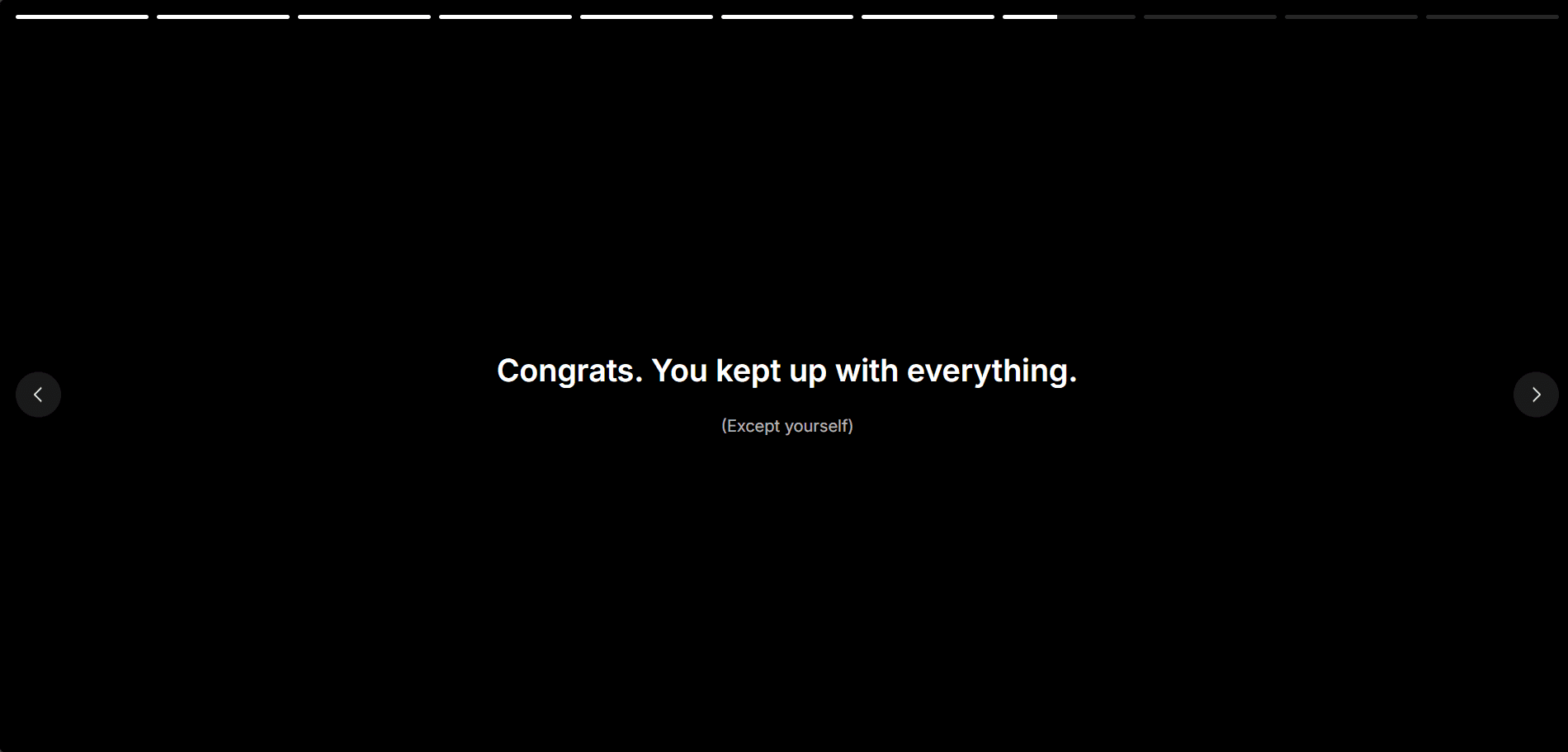
Example slide from the project
2025 Doomscroll Wrapped is a satirical, end-of-year "Wrapped"-inspired web experience that estimates what a year of doomscrolling looked like for the average user. The site uses publicly available usage data paired with conservative assumptions.
This is neither a technical showcase, nor a research subject. Instead, it's an exploration of how design decisions affect how information feels. The project experiments with unconventional design patterns with a single guiding principle: designing for emotional impact.
There are no playful illustrations, trendy visuals, or elegant typography. Instead, the design relies on framing, storytelling, space, and tone to create emotional impact.
Design Patterns
Framing changes meaning
The same numbers can communicate entirely different messages depending on framing.
For example:
- “2 hours and 39 minutes per day” feels acceptable
- “40 days per year” feels uncomfortable
- “88% of your free time” feels confronting
In this project, information is intentionally reframed into human units like days, habits, and tradeoffs, rather than abstract metrics. By presenting data for people to naturally understand, the experience reduces cognitive effort and shifts focus from analysis to reflection. The information doesn't change; only the perspective does.
Data-driven storytelling
This project uses data with a clear purpose: emotional resonance.
The data itself is simple:
- Annual totals
- Proportions of a year
- Estimated ad exposure
- Well-documented behavioral patterns such as memory loss and loss of intent
None of these figures are shocking in isolation. Their impact comes from how they are sequenced and contextualized.
Statistics establish scale.
Habits provide evidence.
Trade-offs reveal consequences.
By arranging information intentionally, the data reflects personal experiences and shifts the response from analysis to recognition.
Space
Space is critical. Not just on the screen, but also in the mind.
The design is deliberately minimal. Whitespace and restraint focus user attention entirely on the message. A dense or busy interface would overwhelm users and distract their attention.
No charts, tables, or graphs were used to support the data: when users need to analyze data, they often forget to reflect on it's meaning.
Space also informs timing. The pace is slow by design: each slide exists in isolation, presenting one idea at a time. Pacing gives the user space to think and reflect - the opposite of the addictive scrolling behavior it critiques.
Tone
The tone deliberately avoids moralizing. Doomscrolling is a shared, normalized behavior, not a personal failure. Humor and irony is used to disarm, creating space for recognition rather than guilt.
Language choices are precise. Statements are presented with a dry, observational quality, allowing the implication to land without explanation or instruction.
For example, instead of stating: "You watched a lot of ads this year",
the experience reframes it as: "Your attention funded 23,277 ads. Instagram, TikTok, and YouTube send their regards."
The message is the same, but the tone changes how it's received. Users aren't accused or instructed; they're invited to notice.
This tonal restraint is critical to the project's goal. Reflection is far more effective when it feels self-discovered rather than imposed.
How is this relevant?
This project pushes the idea that designing for emotion matters as much as designing for usability or aesthetics. A product that feels meaningful and relatable leaves a stronger impression than one that simply looks polished.
The ideas explored here are broadly relevant across disciplines:
- Product design: framing data around user frustrations and realities
- Copywriting: speaking to emotional truths rather than surface metrics
- User experience: building customer sentiment and brand identity
Final note
Good design follows the screen.
Great design follows the heart.
Start designing for feelings, not pixels.